
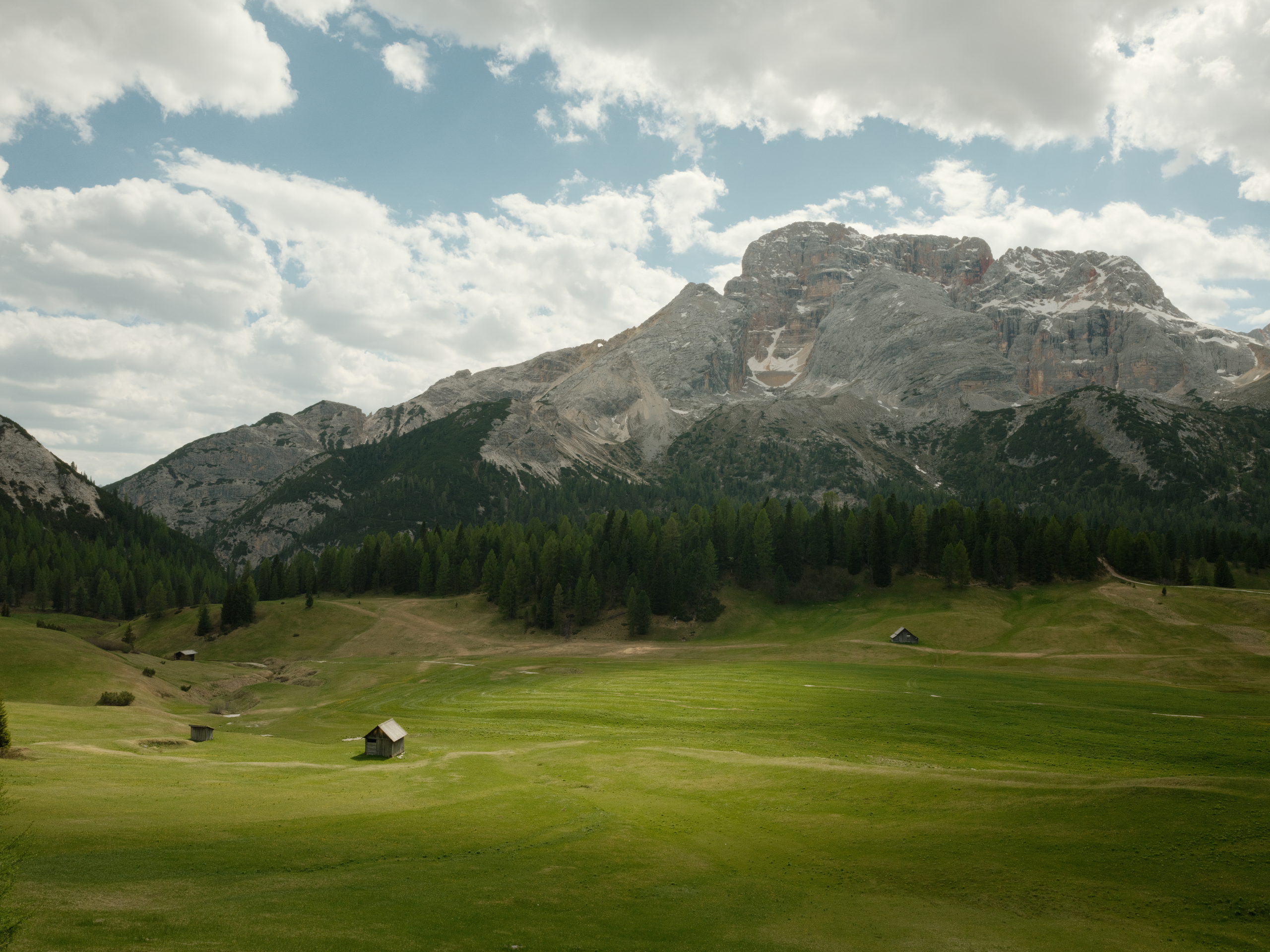

The first half of this journey ended in the south, with plainchant dissolving into an olive grove at Sant’Antimo and Brunello still in the glass. The second half turns north — away from the wine hills and the lake towns, away from the Medici and the Etruscans — and climbs toward a landscape that operates at a completely different scale. The Dolomites are not a more dramatic version of Tuscany. They are a different argument about what Italy can be, made by a different kind of stone, in a different kind of light, at an altitude where the ordinary rules of proportion cease to apply.
The drive north is the longest leg of the trip — the better part of a day, through Florence, Bologna, and up the Adige valley through Bolzano, where the landscape shifts its register definitively: the signage goes bilingual, the food goes alpine, the architecture becomes a negotiation between Italy and Tyrol. The mountains, which have been visible on the horizon for an hour, are suddenly present in a way that maps do not prepare you for.
The Dolomites: Cortina d’Ampezzo and the Tre Cime di Lavaredo
Cortina d’Ampezzo

Cortina sits in an amphitheatre formed by the Cristallo, Tofana, and Faloria massifs, its streets shaded by the kind of peaks that make ordinary language feel insufficient. The town hosted the 1956 Winter Olympics and is co-hosting the 2026 Games — a double distinction that it wears with the assurance of somewhere that has always known it was beautiful and has long since stopped requiring external confirmation. The corso in the evening fills with people who have been in the mountains all day and changed for dinner, and the whole performance has the easy confidence of a place that has been doing this for a very long time.
Eat well. The Dolomites sit at a crossroads between Italian technique and Tyrolean ingredient — speck, wild mushrooms, buckwheat, canederli dumplings floating in a clear, resonant broth — and the combination is not a compromise but a cuisine.
Tre Cime di Lavaredo

From Cortina, the road to the Tre Cime di Lavaredo runs east through Misurina and up a toll road to the Rifugio Auronzo at 2,333 metres, from which the loop trail begins. The Tre Cime — Cima Piccola, Cima Grande, Cima Ovest — are three vertical pillars of Dolomite limestone rising above 2,900 metres, the official symbol of the UNESCO World Heritage Site and, in some sense, the emblem of everything the Dolomites are. Their north faces have never been adequately photographed; the only way to see them is to walk around to Rifugio Locatelli and look back.
The ten-kilometre circuit is not technically demanding. What it demands, instead, is that you pay attention — to the way the peaks change shape as you move, to the remnants of First World War trenches still visible beneath the turf along the trail (this ridge straddled the front line between Italy and Austria-Hungary, and the mountain held both armies for years), to the scale of things, which the human eye keeps attempting to rationalize and keeps failing to. Start early. The trail is busy in summer, and the best views are in the morning light, before the afternoon clouds build over the peaks.
A Brief Crossing: Sillian, East Tyrol

The border between Italy and Austria, in this part of the world, is not a barrier but a suggestion. Drive north from San Candido along the Puster Valley — the valley the Italians call Val Pusteria and the Austrians call Hochpustertal — and the border passes without ceremony, the road simply continuing through the same landscape while the farmhouses acquire steeper rooflines and the signs become exclusively German.
Sillian is the main village of the Austrian side of the valley, sitting at 1,100 metres on the sunny slopes north of the Drava river, the western municipal border coinciding precisely with the national frontier. It is the kind of place that exists because valleys need organizing points — a market square, a parish church, a mountain above it (the Thurntaler, at 2,400 metres) that the locals regard with proprietorial pride. The Lienz Dolomites rise to the south, their limestone pale against the sky in a way that is unmistakably familiar but not, geologically, the same rock.
Have a coffee. Buy something from the farmers’ market if it is open. Allow yourself the minor disorientation of having driven across a national border without noticing and of finding yourself in a country that, from where you are standing, feels completely continuous with the one you left.
Back into Italy: Lago di Braies and Val di Funes
Lago di Braies

Return south across the border and follow the valley road to Lago di Braies — Pragser Wildsee in German, the Pragser Wildsee being the name that appears on older maps and that the local population still uses without apology. The lake sits in a glacial cirque in the Sesto Dolomites, emerald-green, enclosed by vertical rock walls and dark fir forests, with a single wooden boathouse at the water’s edge that has appeared in so many photographs it has acquired a kind of autonomous fame.
Arrive early — before eight, if possible. By mid-morning in summer the car parks are full and the path around the lake is busy in a way that changes the nature of the experience. In the early light, with the peaks reflected in the water and the forest still in shadow, it is simply one of the most beautiful places in the Alps, and there is no elaboration that improves on that fact.
Val di Funes

From Braies, drive west into Val di Funes — the Villnösstal in German — a South Tyrolean valley that exists in a state of almost theatrical perfection. The Odle group of peaks, the Geisler Spitzen, rise above the valley in a line of vertical limestone towers that look as though they were designed to be photographed from below, which they were not, but which accommodates the impulse graciously.
The village of Santa Maddalena occupies the meadows beneath the peaks, and its small church — a seventeenth-century Gothic building first mentioned in records from 1394 — sits on a green hill with the full massif behind it. The image of that church against those peaks is one of the most replicated photographs in the Dolomites, which is one way of saying it is genuinely extraordinary. The twenty-minute walk above the village to the Panorama viewpoint gives you that image from the angle that has made it famous, and the walk back down through the meadows, with the evening alpenglow turning the Odle towers from white to pink to the deep carmine the locals call Enrosadira, is a reasonable argument for extending this detour by a full day.
The valley is also the gateway to the Puez-Odle Nature Park, from which the Adolf Munkel Trail runs at the foot of the Odle group through high alpine pastures where the views extend further than seems physically possible. But the meadows below Santa Maddalena will do, if time is short. The Dolomites have a way of making everything else feel like a lesser argument.
Milan: The Quadrilatero della Moda
The road back to Milan follows the autostrada south, and the city receives you with the confident indifference of a place that has been important for a very long time and expects to continue. You have been in mountains and lake towns and wine cellars for days; Milan, after all that, feels like a gear change.
The Quadrilatero della Moda is bounded by Via Montenapoleone, Via Manzoni, Via della Spiga, and Corso Venezia — four streets that form a luxury district of such concentration that the phrase window shopping takes on a slightly resigned quality. Via Montenapoleone, in 2024, surpassed New York’s Fifth Avenue to become the most expensive retail street in the world by rental cost. The seventeenth- and nineteenth-century palaces that line the streets were built by wealthy Milanese families who wanted to be near the Duomo and near each other; the fashion houses that now occupy them are a later layer of ambition, fitting seamlessly into the logic of conspicuous excellence that the neighbourhood has always understood.
Whether you spend money or simply walk is beside the point. The Quadrilatero in the early evening — when the light is soft and the boutiques are still lit and the streets fill with the particular kind of elegant purposefulness that Milan performs with such ease — is a different city from the one you left at the beginning of the trip. Or perhaps it is the same city, and you are simply paying attention in a way that the road has made possible.
The Road Back

That, in the end, is what a road trip through Italy does to a person. You leave Milan with the Duomo in your rearview mirror and you think you understand the country — its beauty, its pace, its ancient confidence in the worth of pleasure. And then the road spends two weeks dismantling that understanding and building something larger and less tidy in its place. You have tasted what Bottura believes food should be. You have stood among the machines that Enzo Ferrari believed were worth a life’s devotion. You have watched Vino Nobile deepen in a glass in an underground cellar while the light outside turned the Val di Chiana to copper. You have sat on the ramparts above Lake Trasimeno and understood, briefly, why civilisations have always wanted to control this view. You have walked the ridgeline at Tre Cime and felt, in the thin air between the peaks, the particular silence that exists only at altitude — the kind that isn’t the absence of sound but the presence of something older than sound.
There is a version of Italy that is a backdrop: gorgeous, passive, waiting to be photographed. This road doesn’t go to that version. It goes to the one that pushes back — that has opinions about food and wine and speed and stone and beauty, that has been having those opinions for several thousand years and has no intention of revising them. You return to the Quadrilatero slightly altered, trailing road dust and mountain air and the memory of a plainchant dissolving into an olive grove at Sant’Antimo. Milan receives you without comment. The city has seen people come back from the south changed before. It considers this unremarkable.
The Madonnina is still above the rooftops, where she has been since 1774. She watched you leave. She watched you come back. She will be there long after the car is returned and the miles are forgotten — patient, gilded, and entirely unmoved.
Read the previous article here: I Drove Italy’s Most Beautiful Wine Road. Here’s Why You Need to Go.