
Somewhere between the echo of fado drifting from a tiled doorway and the smell of salt air rolling off the Tagus River, you stop walking and just stand there. That’s Lisbon’s trick — it sneaks up on you. And if you think the Portuguese capital is the only place worth falling in love with in this sun-drenched corner of Europe, you haven’t been to Porto yet.
Together, Lisbon and Porto offer one of Europe’s great city pairings — both ancient, both alive, both shaped by the Atlantic and the weight of empire, yet different enough to feel like two distinct arguments for why Portugal deserves more of your time.
Lisbon: A City That Earns Every Cliché
Lisbon doesn’t try to charm you. It just does.
The Portuguese capital is one of Europe’s oldest cities, older than Rome by some reckonings, and it carries that age beautifully — not as museum-piece preservation, but as living architecture. The azulejos (hand-painted blue-and-white tiles) that coat the facades of churches, train stations, and residential walls aren’t decorative relics; they’re the city’s visual language, telling stories of saints, sea voyages, and everyday life.
Alfama: The Soul of Old Lisbon
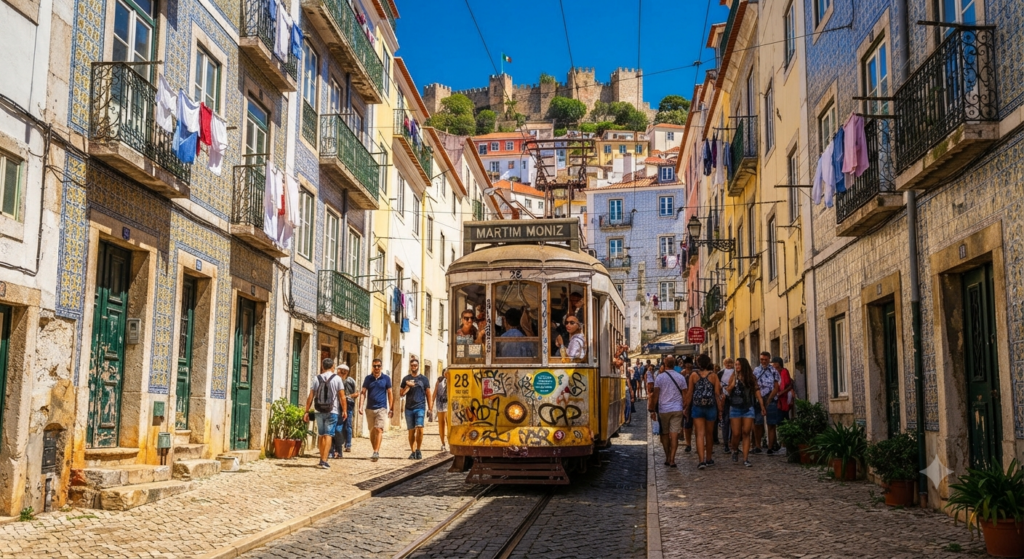
Start in Alfama, the ancient Moorish quarter that tumbles down the hillside toward the river in a tangle of narrow lanes, laundry lines, and the low, mournful sound of fado music. This is the neighbourhood that survived the catastrophic 1755 earthquake largely intact — Alfama sits on solid stone bedrock and was elevated enough to avoid the tsunami that devastated the lower city — and walking through it feels like time-travel with better wine.
Climb to the Castelo de São Jorge at the crest of the hill and you’ll get the full sweep of the city — terracotta rooftops, the silver ribbon of the Tagus, and beyond it, the south bank’s gentle hills. On clear days, you can spot the 25 de Abril Bridge, a striking red silhouette that looks suspiciously familiar to anyone who’s crossed the Golden Gate.
Belém: Where Portugal Met the World
Take the tram or a short Uber west to Belém, the neighbourhood that launched a thousand ships — literally. This is where Vasco da Gama set sail for India in 1497, departing from the riverbank near where the Torre de Belém still stands watch today like a stone sentinel.
But Belém’s most essential stop isn’t a monument. It’s a pastry. The Pastéis de Belém, the original custard tart shop that’s been serving its recipe since 1837, produces something so simple and so perfect that you’ll buy two, eat them, and immediately go back for a third. The filling is silky, the pastry shatters, and the dusting of cinnamon and powdered sugar is non-negotiable.
LX Factory and the Modern Edge
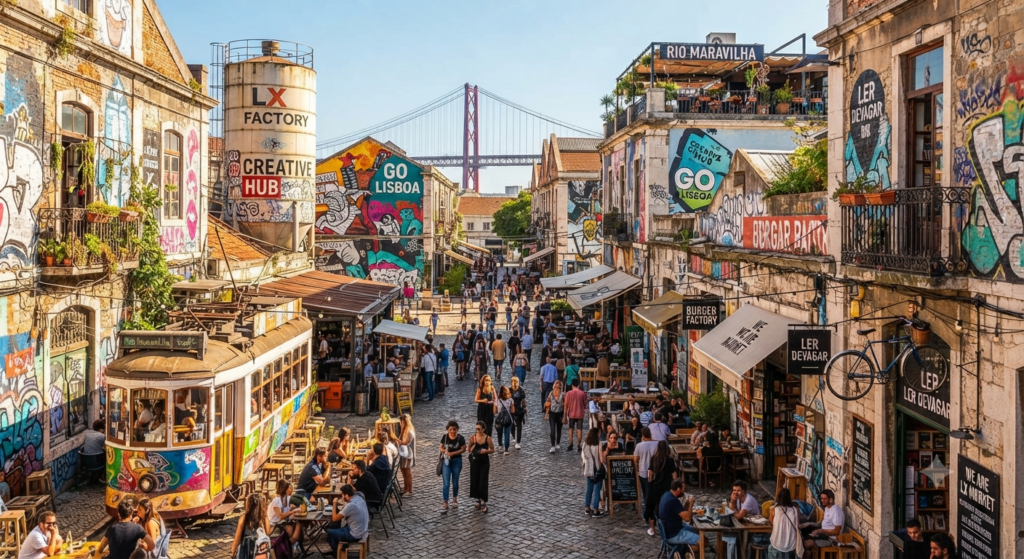
Lisbon has always reinvented itself, and LX Factory is the latest chapter. A textile factory dating to 1846 in the Alcântara district, it was transformed in 2008 into a buzzing creative hub of independent shops, restaurants, studios, and a Sunday market that draws locals and visitors in equal measure. This is where you’ll find concept bookshops, natural wine bars, and vintage clothing stores that make you wish your suitcase had more room.
Porto: Portugal’s Rougher, Realer North
Around three hours up the coast by train, Porto operates at a different frequency. Where Lisbon sprawls and shimmers, Porto piles upward — a dense, dramatic city of granite churches, crumbling baroque facades, and steep streets that drop suddenly to the banks of the Douro River. It’s grittier than Lisbon, more lived-in feeling, and for many travellers, more immediately loveable.
This is a city that doesn’t perform for you. It simply exists, magnificently, and lets you figure out what to do with it.
Ribeira and the Douro
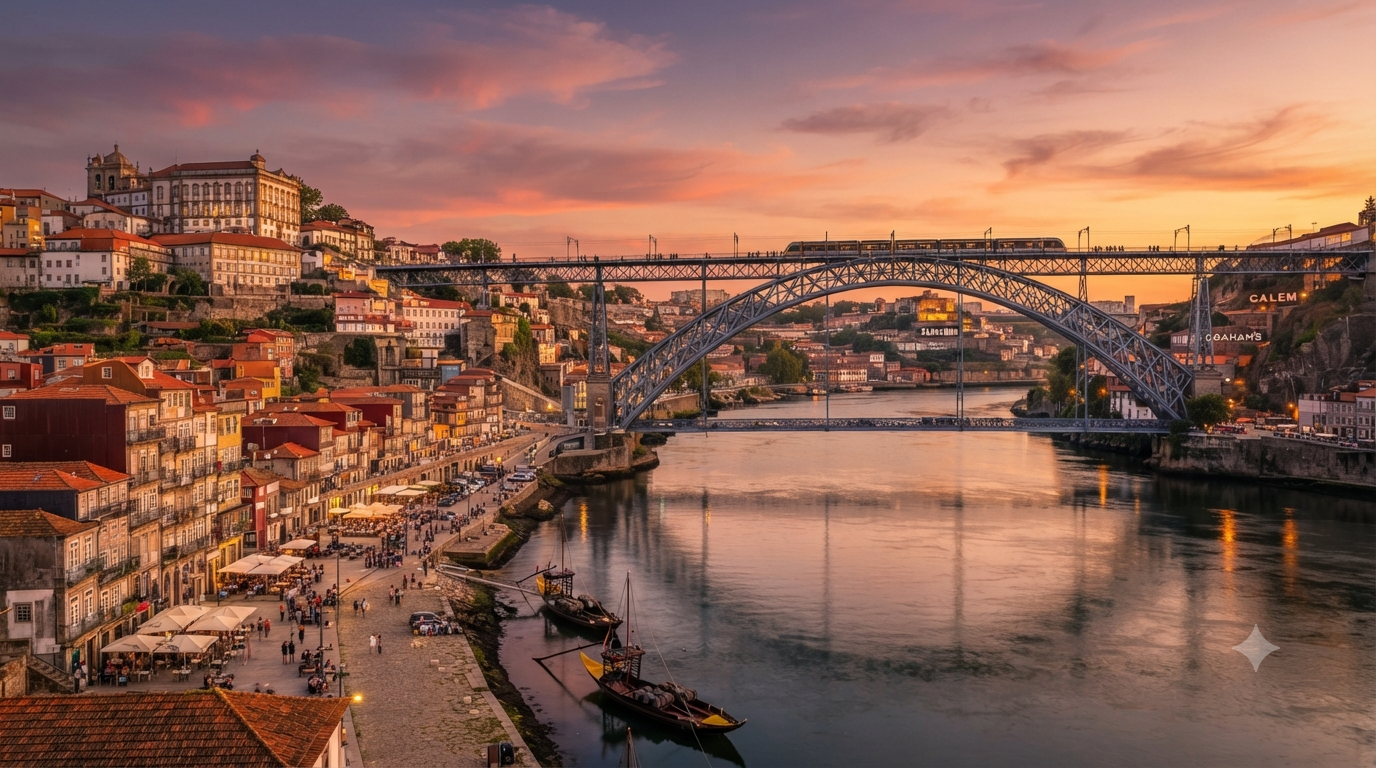
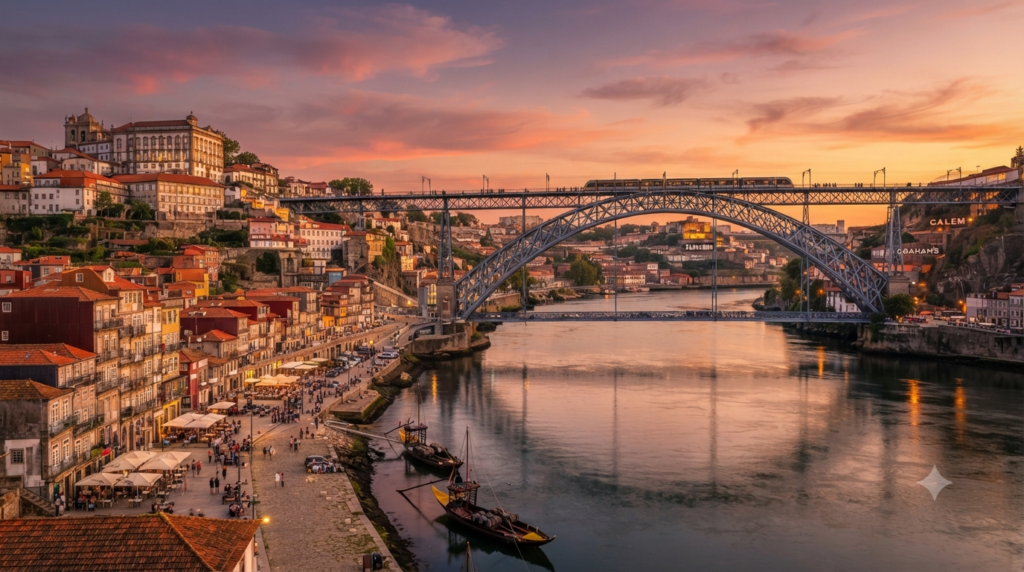
The Ribeira district, Porto’s ancient waterfront quarter, is the natural place to begin. Narrow medieval houses in every shade of faded colour lean over cobblestone lanes that empty onto the riverfront promenade, where traditional flat-bottomed rabelo boats — once used to transport wine barrels down from the Douro Valley — bob gently at their moorings.
Across the river in Vila Nova de Gaia, the great port wine lodges line the south bank, their white-painted names visible from almost anywhere in the city. A tour and tasting at one of the historic lodges — Sandeman, Graham’s, Ramos Pinto — is one of Portugal’s essential experiences: cool, vaulted cellars, centuries of barrels, and a glass of tawny that makes you wonder why you’ve been drinking anything else.
The Tiles and the Bookshop
Porto’s azulejo tradition reaches its apex at Igreja de Santo Ildefonso, a church whose exterior is wrapped in around 11,000 blue-and-white tiles depicting biblical scenes and the life of Saint Ildefonso — placed in 1932 by artist Jorge Colaço. Standing in the square in front of it on a bright morning is one of those travel moments that needs no filter and no caption.
A short walk away, Livraria Lello has been called one of the world’s most beautiful bookshops, and for once the hyperbole is justified. The neo-Gothic facade, the sinuous red staircase, the stained-glass ceiling — it’s a building that makes you want to read more. Buy a book. They’ve earned it.
The Food That Defines the City
Porto’s signature dish is the francesinha — a towering, artery-defying sandwich of cured meats and melted cheese, drowned in a spiced beer-and-tomato sauce and topped with a fried egg. It sounds excessive because it is. It also tastes extraordinary. Order it at a classic spot like Café Santiago and commit fully to the experience.
Beyond the francesinha, Porto’s food scene has evolved dramatically. The Mercado do Bolhão, a historic market with roots going back to 1839 and a neoclassical iron building inaugurated in 1914, reopened after full restoration in 2022 and is the best place to graze — fresh bread, local cheese, charcuterie, salt cod in a dozen preparations, and pastries that disappear fast. In the evenings, the restaurants of Rua de Miguel Bombarda and the Bonfim neighbourhood offer everything from traditional tasca cooking to some of the most exciting contemporary Portuguese food in the country.
Practical Notes for the Journey
Getting to Lisbon: Humberto Delgado Airport is well-connected to most of Europe and North America. From the airport, the metro drops you into the city centre in about 25 minutes.
Getting around Lisbon: The city is famously hilly, and the trams (especially the iconic 28E route through Alfama) are worth riding at least once, tourist crowds and all. For longer distances, rideshares and the metro are fast and cheap.
Getting to Porto: The train from Lisbon’s Santa Apolónia station to Porto Campanhã takes around three hours on the Alfa Pendular service — Portugal’s high-speed intercity train, with free Wi-Fi and a café onboard — and offers a comfortable, scenic journey through the Portuguese interior. Porto also has its own international airport with strong connections across Europe.
Getting around Porto: The city is compact enough to walk most of, though the hills are serious. The metro is clean and efficient for longer trips, and the historic trams — especially line 1 along the Douro — are worth taking for the views alone.
When to go: April through June and September through October give you warm weather, manageable crowds, and that particular quality of light — golden and unhurried — that makes Portugal look like a painting.
The Lasting Impression
What stays with you after Lisbon and Porto isn’t any single monument or meal. It’s the texture of the experience — the way afternoon light turns terracotta rooftops amber, the sound of a fado singer through an open window in Alfama, the view of the Douro from a hilltop miradouro in Porto with a glass of wine in hand.
Portugal has been discovered, yes. But it hasn’t been spoiled. Come now, while the custard tarts are still warm and the port wine cellars still smell of oak and time and the streets reward slow walking.
Two cities. One country. No bad choices.